
Arc Melting Furnace
What is an Arc Melting Furnace ?
- An Arc Melting Furnace is a compact, laboratory-scale melting system that uses a high-current electric arc to melt conductive metals and alloys under inert gas or vacuum conditions.
- An Arc Melting Furnace system can instantly reach temperatures above 3,500 °C, making it ideal for university laboratories and R&D research facilities requiring high-purity metal melting.
- Thanks to its efficient exhaust and gas handling system and a 100% duty-cycle power supply, the Arc Melting Furnace enables continuous operation without downtime, offering both high reliability and cost-effective performance for research applications.
Arc Melting Furnace vs Induction Furnace – Comparison Table
Arc Melting Furnace Systems by MRF (USA)
MRF (USA) designs and manufactures a wide range of high-quality arc melting furnace, from compact laboratory systems to advanced high-vacuum and crystal-growth configurations, covering diverse research and industrial requirements.
Crystal-Type Arc Melting Furnaces
- Single-arc or multi-arc configurations
- Compact footprint, excellent visibility
Bell Jar-Type Arc Melting Furnaces
- a water-cooled stainless-steel double-wall vacuum chamber,
- providing superior sealing performance and precise control of vacuum level, residual gases, and inert atmospheres
- This configuration is preferred for high-vacuum and high-purity materials research
Single Arc vs Tri-Arc Melting
- Single Arc Melting Furnace are the standard choice for research-scale applications involving samples below 1 kg.
- Single Arc offer high process stability, excellent melt purity, simple manual control, and minimal installation space requirements.
- Tri-Arc systems provide more uniform heating for larger samples but involve increased system complexity and higher power consumption.
Key Features of Arc Melting Furnace
- Maximum attainable temperature: above 3,500 °C
- Inert gas (argon) and vacuum operation
- Water-cooled copper hearth plate to minimize contamination
- Manual arc sweeping using a movable electrode (stinger)
- Compact footprint with optional casters for mobility
- Fully tested turnkey system prior to shipment
Typical Applications
- High-purity metal melting
- Alloy development
- Arc casting and metallic button preparation
- Material densification
- Annealing and crucible welding
Optional Configurations
- Load lock system
- Rotating hearth for uniform melting
- High-vacuum Option (Turbo Pump)
- Tri-arc (three-electrode) configuration
- Crystal growth option for directional solidification and single-crystal research
Why Choose an Arc Melting Furnace?
For conductive metals, arc melting furnace is often more economical and efficient than induction or resistance heating systems, while delivering superior purity and rapid melting performance for advanced research applications.
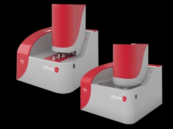
MRF, USA – Arc Melting Furnace – 5 Models
아래 모델 클릭하시면은 상세 사양 검토 가능 합니다.
Arc Melt Furnace SA-200 ; Crystal Type, Single Arc
Arc Melt Furnace TA-200 ; Crystal Type, Tri Arc
Arc Melt Furnace ABJ-338 ; Bell Jar Type, Single Arc, Small
Arc Melt Furnace ABJ-900 ; Bell Jar Type, Tri Arc, Big
Tri-Arc Melt Furnace ABJ-900-3 ; Bell Jar Type, Tri Arc, Big, (Optional Czochralski Single Crystal Growth System )
Meaning of Model Numbers
The model numbers SA-200, ABJ-338, and ABJ-900 indicate the diameter of the copper hearth plate used in the arc melting furnace.
200 = 2-inch diameter (approximately 50 mm)
338 = 3.38-inch diameter (approximately 85.8 mm)
900 = 9-inch diameter (approximately 228 mm)
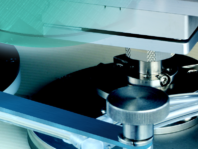
The hearth plate supports the sample during melting and incorporates an internal water-cooling system to prevent contamination and material adhesion.
It also features a machined cavity where the sample is placed, effectively functioning as a sample holder for arc melting processes.
MRF사, Arc Melting Furnace for Laboratory and R&D
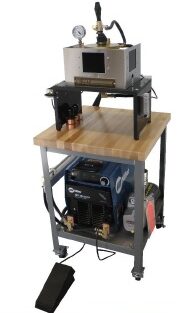
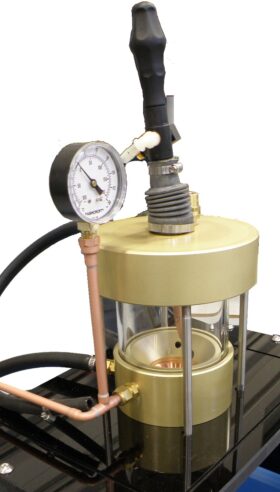
Crystal Type, Model SA-200 (Arc 1EA)
CASTER :
→
MRF Arc Melting Furnaces are designed with a compact footprint requiring minimal floor space, and are equipped with casters for easy mobility and convenient operation within the laboratory.
Arc Melting Furnace Chamber :
- Arc Melting Furnaces are easy to operate and enable rapid, high-purity metal melting.
- For conductive materials, arc melting offers a cost-effective alternative to induction and resistance heating systems.

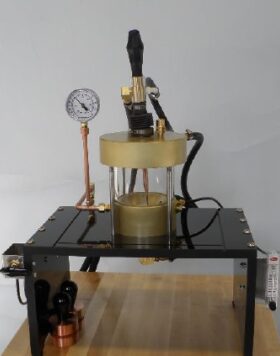
- Arc melting chamber equipped with a stinger.
- For improved visibility, the welding safety glass is removed in this image.
- The system includes a load lock, splat rod, and a single stinger.
Stinger: A movable electrode holder that conducts high current from the power supply to the tungsten electrode.
- This system is a standard configuration equipped with an integrated gas supply and vacuum system.
- For clarity, the safety glass (welding filter) and protective shields normally installed have been removed in the image to show the internal structure.
A video of the crystal-type TA-200 model operating with three arcs is shown below.
Features of 3 Arc :
Structure:
The system uses three electrodes to generate three arcs and operates on a three-phase power supply.
Melting Characteristics:
Each arc distributes heat evenly across the melting zone, resulting in a uniform temperature distribution.
This allows efficient melting of large metal samples exceeding 1 kg.
Applications:
Tri-arc systems are typically used in large-scale industrial melting applications, such as steel production and bulk metal processing.
Advantages:
Highly efficient for large metal masses and high-temperature operations, offering fast and stable melting performance.
Limitations:
The system has a more complex structure, higher initial installation cost, and greater power consumption.
For pure research applications involving samples below 1 kg, a single-arc system can be a more practical choice, offering advantages such as reduced installation space and simpler operation.
The key advantages of single-arc melting are high stability, high-purity melting, and simple, intuitive control.
For these reasons, single-arc configurations are the standard design for laboratory-scale arc melting systems.
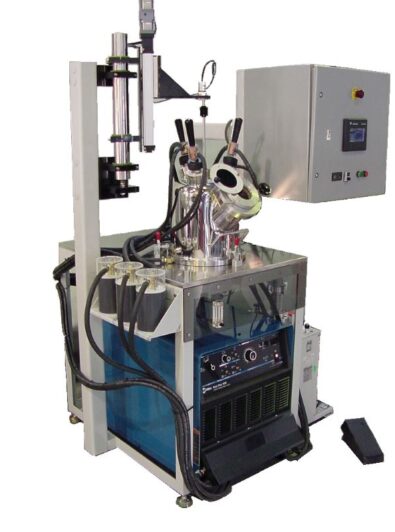
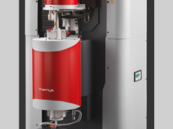
Model ABJ-900-3 : (Bell Jar Type, Three Arc )
- The MRF ABJ-900-3 Arc Melting Furnace is a bell jar–type system designed for large-scale melting, featuring a 9-inch diameter copper hearth capable of melting multi-kilogram alloy samples in a single run.
- The system can instantly reach temperatures above 3,500 °C, and its Tri-Arc configuration ensures uniform melting and reliable production of large alloy batches.
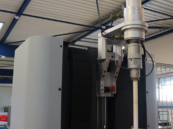
- By adding the optional Czochralski Single Crystal Growth System, the furnace enables directional solidification through seed pulling in an arc-melting environment.
- This configuration is well suited for metal single-crystal growth, microstructure control of ultra-high-temperature alloys, and advanced materials research.
- The optional crystal growth kit can be integrated with a high-precision motion system and crucible, supporting Czochralski-type crystal growth for materials such as:
- Single-crystal silicon
- Sapphire and YAG-type oxide crystals
- Optical crystals such as LiNbO₃ and LiTaO₃
- Laser-grade garnet and spinel materials
- Specialized compound semiconductors
- Dedicated crystal growth furnaces (Czochralski, Bridgman, and Stepanov types) are also available separately.
Model SA-200 Crystal Type Arc Melting Furnace Specifications :
- Operating temperature: over 3500 ℃.
- Bottom loading configuration.
- 360o viewing through Pyrex glass between top and bottom brass base.
- Vacuum chamber construction.
- Copper stinger with tungsten electrode.
- Copper hearth plate 2.0” dia. (51mm dia.) usable
- 2.0” Diameter (50.8mm) available working surface X 3/8” (9.5mm) deep. Largest working volume is 1.18 cu/in (19.3 cc)
- Power Supply: 300 Amp @ 60% DS, 15Kva.
- Water-cooled power cables
- Inert gas system with relief valve.
- Pumping system with roughing pump, vacuum gauge and valve.
Major System Components :
1. Furnace Chamber :
- The chamber consists of a brass bottom and top with a Pyrex viewing tube.
- The chamber top and base are water-cooled to maintain a chamber temperature below 50C (120F) during normal use.
- The chamber is rated for vacuum to 10-2 Torr (Mbar)
- The chamber top houses the stinger assembly
- Access to the furnace for loading and unloading is through the bottom cover.
- Clamps are provided to isolate and seal the chamber atmosphere
- Vacuum and gas port is supplied.
- Three welding glasses are provided, allowing arc viewing from three sides


한미산업
1999년 개업 이후, 지난 30여년간
- Tribology(마찰/마모/윤활/CMP 연마), 스크래치, 고온 경도계, 베어링 시험기 : 미유럽 일본의 유명 제조공급사인 BRUKER, PHOENIX Tribology, TABER, SHINTO Heidon, INNOWEP, AMTEC, TRICO사.
- 열분석기(DSC,TGA,STA,TMA), 고온진공로 : 스위스 KEP 그룹의 SETARAM SETSAFE, 미국 MRF사, 일본 ENEOS MATERIALS사의 수지 열경화 시험기 등
최첨단 장비들을 국내에 소개 및 판매 기술 지원하여 왔으며, 또한 이기술을 바탕으로 일부 품목 제조를 통하여 국산화에도 노력하여 왔습니다. 앞으로도 더욱 노력하여 국내 기술 발전에 이바지 하도록 하겠습니다.
상호: 한미산업
대표: 최동하
사업자등록번호: 219-02-82992
Address
서울특별시 송파구 송파대로 167, 문정역 테라타워 A동 6층 619호. (문정동 651) 우편번호 05855
찾아오시는 길
서울 지하철 8호선 문정역 3번 출구에서 도보 약 300m 거리에 위치해 있으며, 지하 보행 통로로도 연결되어 있어 우천 시에도 편리하게 방문하실 수 있습니다.
Tel. 02-3411-0173
Fax. 02-3411-0178
choi.dongha77@gmail.com
견적문의
한미산업. All rights reserved.